
“Ethical fashion” has been stretched so thin it barely means anything anymore. A brand can put “conscious collection” on a polyester dress made in an unaudited factory, and nobody stops them. Meanwhile, companies doing real work on supply chains and fair wages tend to be quieter about it than the ones that aren’t.
Below, we tell what ethical fashion means in practice, which certifications hold up, what the fabrics are about, and how to build a wardrobe that lasts. Without making it sound like a moral test, you can only pass by spending $300 on a linen shirt.
What Is Ethical Fashion?
Ethical fashion means designing, making, and selling clothes in a way that causes less harm, to workers, communities, and the environment. It’s not a single standard or a certification. It’s a direction.
Here’s what it’s responding to:
Problem | Scale |
|---|---|
Textile waste generated globally every year | ~92 million tonnes |
Garment workers frequently paid below living wage | Documented across Bangladesh, Cambodia, India, Ethiopia |
Conventional cotton’s share of global pesticide use | 25% of pesticides on 3% of farmland |
Share of clothing worn fewer than 5 times before disposal | Significant portion across all markets |
No brand solves all of this. Ethical fashion is a spectrum: from brands that have done the minimum to ones with third-party audited supply chains and transparent wage disclosures. The job isn’t to find a perfect option. It’s to understand where something sits on that spectrum.
Fair Trade Certification Explained
Fair Trade is one of the most recognized ethical labels in clothing, and one of the most misunderstood.
It focuses on labour conditions and wages. Certified producers must receive at least the Fairtrade Minimum Price, which covers the average cost of sustainable production. On top of that, buyers pay a Fairtrade Premium – an extra amount that producer organizations invest in their communities, infrastructure, or business development.
The auditing is done by FLOCERT, an independent body checking compliance across more than 70 countries. Auditors are typically local to the region they’re assessing. Certification involves on-site inspections, regular surveillance audits, and unannounced checks when specific concerns come up.
It’s not a perfect system. A few things worth knowing:
- Fairtrade producers can typically only sell between 18–37% of their output as Fairtrade certified. The rest goes to market at standard prices.
- Certification requires cooperatives to meet strict organizational standards which means the farmers who benefit most tend to be those already relatively organized, not those in the most precarious situations.
- Fair Trade says more about labour than about environmental impact or material quality. A Fair Trade certified garment might still be made from conventional cotton.
Organic Cotton vs Conventional Cotton
Organic cotton clothing comes up constantly in sustainable fashion, but the claims are worth looking at carefully.
“Organic cotton can require more land, water, and energy, which eventually causes higher greenhouse gas emissions.”
– Kavita Mathur, PhD, Department of Textile and Apparel, NC State University
Conventional cotton has a genuinely bad environmental record. It uses roughly 25% of global pesticides despite covering only 3% of farmland. The impact on soil, water, and agricultural workers in major producing regions is documented.
Organic cotton avoids synthetic pesticides and fertilizers. That’s real. But the trade-offs matter:
- Organic cotton crops yield approximately 28% less than conventional, so more land and water are needed per kilogram of fibre.
- Organic cotton is not automatically softer or higher quality. Textile quality comes from fibre length, not growing method. Short-staple organic cotton can produce rougher, less durable fabric than long-staple conventional.
What to look for on labels:
GOTS (Global Organic Textile Standard) is the most reliable verification for organic cotton clothing. It covers the fibre, the processing, and basic labour standards. Products with 95%+ organic content carry the “organic” label. Those with 70–94% say “made with organic materials.”
One more thing: in 2022, a New York Times investigation found that much of the cotton exported from India as “organic” may not be genuine. Self-declared organic claims without third-party certification are not reliable.
What’s in Your Clothes?
You’ll see the same materials come up in ethical clothing over and over. Worth knowing what they mean before you see them on a tag.
Fabric | What it is | Pros | Catch |
|---|---|---|---|
Linen | Made from flax | Low pesticide/water use, biodegradable | Quality varies by processing method |
Hemp | Made from hemp plant | Strong, durable, low-input growing | Historically coarse; lighter versions are newer |
Tencel (lyocell) | Wood pulp, closed-loop solvent process | Soft, drapes well, more biodegradable than synthetics | Generic lyocell varies; look for the Lenzing Tencel label |
Recycled polyester | Made from plastic bottles | 75% lower carbon footprint than virgin polyester | Still sheds microplastics; doesn’t biodegrade |
Recycled nylon | Reclaimed fishing nets or fabric waste | Reduces ocean plastic; durable | Same microplastic issue as recycled poly |
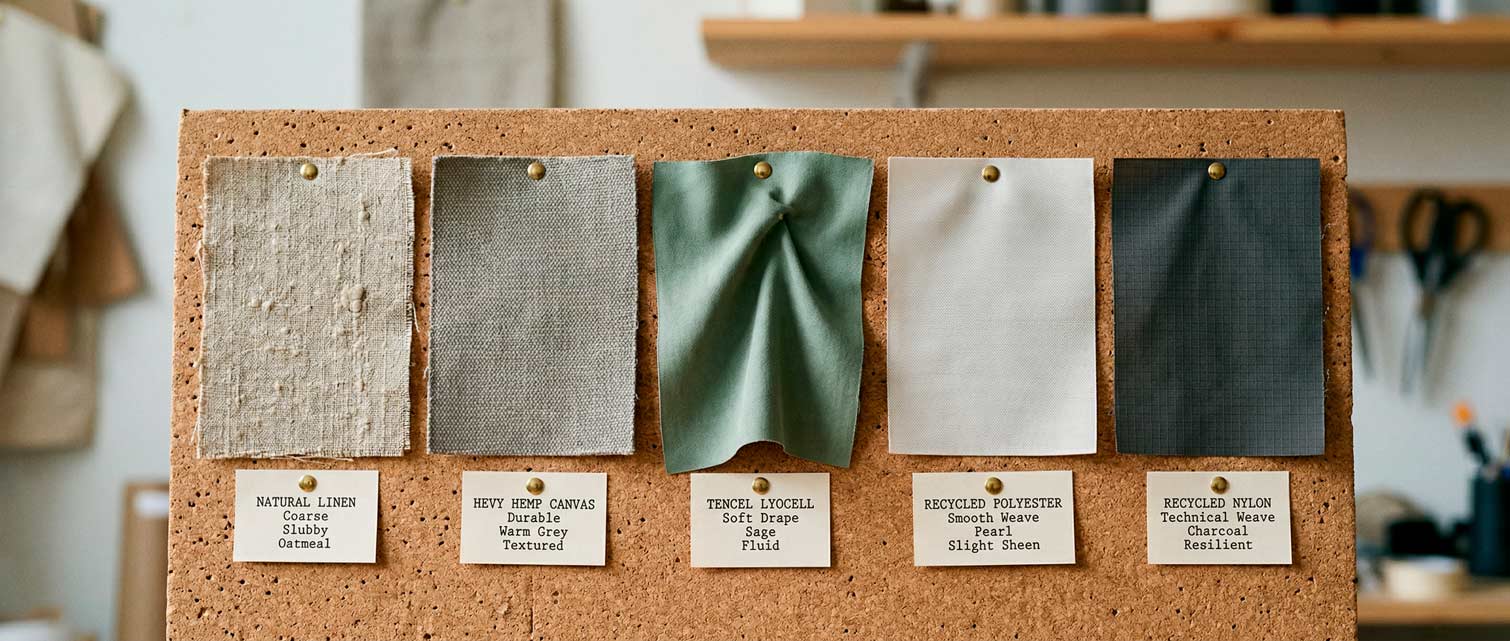
“Recycled” and “natural” on a label are starting points, not conclusions. What matters is whether the claim is verified and what the full production process looks like.
OEKO-TEX and GOTS Certifications
These two labels appear on a lot of ethical clothing. They cover different things, and it’s easy to mix them up.
OEKO-TEX Standard 100 tests a finished garment for over 1,000 harmful substances – including formaldehyde, azo dyes, heavy metals, phthalates, and pesticide residues. Every component must pass: fabric, thread, buttons, zippers.
What OEKO-TEX does NOT cover: how the garment was made, who made it, or what they were paid. It’s a safety certification, not an ethics certification.
GOTS covers more:
- Requires at least 70% certified organic fibre content
- Restricts dyes and chemical agents used in processing
- Mandates wastewater treatment at manufacturing facilities
- Includes basic labour standards for safe working conditions
Simple comparison:
OEKO-TEX Standard 100 | GOTS | |
|---|---|---|
Tests for harmful substances | Yes | Yes |
Covers fibre origin | No | Yes (organic required) |
Covers labour conditions | No | Partially |
Covers processing chemistry | Partially | Yes |
Third-party verified | Yes | Yes |
An OEKO-TEX label means the garment is safe to wear. A GOTS label means it was made from organic fibre, processed more cleanly, and produced with some social standards in place. Both require external verification. Neither is a guarantee of a perfect product.
How to Build an Ethical Wardrobe
The practical case for a better wardrobe isn’t primarily moral. It’s financial.
Buying fewer, better-made pieces costs less over time, produces less waste, and results in a wardrobe that’s easier to get dressed from. A well-made little black dress in Canada’s range of climates needs to earn its keep across seasons. A jumpsuit that only works for one type of occasion isn’t a good investment, regardless of what it’s made from. A maxi skirt that holds up to repeated washing and doesn’t lose its shape after a season is worth several cheap alternatives.
Ethical pricing reflects real costs: an organic cotton T-shirt in Canada typically runs $70–90, and a responsibly produced dress can reach $200–250 or more. That premium exists because someone in the supply chain is being paid fairly and the materials were grown without synthetic pesticides. Whether that trade-off makes sense depends on how often you’ll wear it.
Before buying anything new, run through this:
- What is it made from, and is that actually disclosed on the brand’s website?
- Is there a third-party certification, or just a brand claim?
- Does the brand publish supplier information, named factories, not just “ethically made”?
- Will you wear this more than 30 times?
That last question isn’t rhetorical. Research shows a significant portion of clothing purchased in Canada is worn fewer than five times. The environmental cost of a garment is mostly fixed at production, the more times you wear it, the smaller the per-wear footprint.
Secondhand is a legitimate first option, not a backup plan. Sustainable clothing in Canada is widely available through resale platforms, consignment shops, and clothing swaps. Quality pieces from a decade ago are often better constructed than new equivalents at the same price point.
Sustainable Fashion in Canada: What’s Changed
Canada’s ethical fashion infrastructure has grown a lot since 2020. Cities like Montréal, Toronto, and Vancouver have expanding communities of independent labels with transparent supply chains, and domestic production, while still niche, is more accessible than before.
A few things specific to Canada that other guides tend to skip:
Bill S-211 came into force on January 1, 2024. The Fighting Against Forced Labour and Child Labour in Supply Chains Act requires companies above certain size thresholds to report annually on steps taken to reduce the risk of forced labour and child labour in their supply chains. It doesn’t ban anything, it mandates disclosure, but it has raised the floor for corporate accountability in Canadian retail, with penalties of up to $250,000 for non-compliance.
Extended producer responsibility for textiles is still developing provincially, but it’s moving. Several provinces are advancing legislation that would require brands to fund end-of-life collection programmes for clothing and textiles. When that happens, it will change the economics of fast fashion in the Canadian market.
Duties and shipping are real factors when buying from European or US brands. Domestic brands typically offer shipping at rates comparable to conventional retailers. For international orders, it’s worth checking whether a brand has Canadian distribution before ordering direct.
FAQs
Is OEKO-TEX certified clothing worth paying more for?
Yes, if chemical safety matters to you, especially for items worn close to skin like underwear or baby clothing. Whether a specific price premium is worth it depends on the gap and the item.
What’s the difference between fair trade clothing and organic cotton clothing?
Fair Trade is about labour and wages. Organic cotton is about how the fibre was grown. A garment can be one, both, or neither. They address different parts of the supply chain.
How do I know if “sustainable” or “eco” claims on a label are real?
Look for the certification behind the claim. GOTS, OEKO-TEX, Fair Trade, B Corp, and Bluesign all require third-party verification. Self-declared terms like “eco-friendly,” “conscious,” or “sustainable materials” are unregulated in Canada and mean whatever the brand wants them to mean.
Does it matter where clothing is made?
Country of origin alone doesn’t tell you much. A garment made in Bangladesh in a certified, audited factory may be produced more responsibly than one made in a country with strong labour laws but no oversight on that specific factory. Certification matters more than geography.
Is sustainable clothing in Canada more expensive to ship?
Domestic brands typically offer shipping comparable to conventional retailers. International sustainable brands, particularly from Europe, can involve duties and higher shipping costs.